Volume 8, No. 11, November 2026
Editor: Rashed Rahman
The Flight of the Anka
Navid Shahzad
Faiz’s land. Stretching from Azad Kashmir in the north, undulating gently towards Sindh in the south, bordered by a sun-ripened Indian Punjab on the east and closed in by a rugged west. For Faiz, a descendant of Muslim peasants of the Punjab, it was a land riddled with contradictions, old and new. The lunar world of Urdu poetry, with its exotic sounds – evocative and ancestral – had formed the backbone of Muslim identity in an undivided India, where ideally love stood somewhere between life and art, and intriguing ambiguity, coupled with a diversity of meaning, was the essence of poetic style. But where the classical poet had roamed the invisible rather than the visible world, Faiz chose to see the landscape washed by sunlight.
The first All India Progressive Writers’ Conference was held in Lucknow on April 10, 1936. Iqbal died two years later. In more ways than one, Faiz stood at a new point in history, and the new movement repudiated not only middle-class morality but also its literature. The fifty years between Hali and Iqbal are singularly devoid of good love poetry because the moral levity of the old aristocracy had bred a genuine horror of sex.
By the thirties, India’s virile middle class, which had begun displacing the aristocracy as early as the early 19th century, was itself being displaced by a moneyless, critical and intellectual class. It was a class that had matured on the writings of Maupassant, that apostle of individualism, Ibsen, Gide and Lawrence. Freud and Steckel provided scientific cover for a whole new generation preoccupied with exploring the self. Unwilling to worship at the feet of the middle-class gods, this class talked of religion in terms of organised hypocrisy. Radical in politics, it repudiated revivalism and believed in exposing the cruelty and injustice inherent in a capitalist system.
The initial response was a spate of poems and short stories dealing with sex. Faiz’s work shows no such coarseness or exhibitionism. For him, the realm of love was closer to art and fancy; he entered the scene as Iqbal was taking leave of it and by 1939 was already showing promise of delicacy and suggestiveness; qualities that were to defy translators:
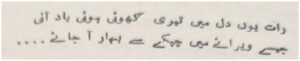
Faiz’s initial journeys of discovery were those of mind, during which he remained faithful to an enlightened humanism that took him beyond the confines imposed on the persona of a poet. He confesses ruefully:

And then suddenly a crucial episode in Faiz’s life changed the nature, the very essence of poetry:

I sold my heart and bought Life! And with that, Faiz’s efforts began to hinge on a synthesis of Eastern faith and Western reason in a socialist form. Haunted by the spectre of crumbling walls and remains of an age gone by, Faiz set aside nostalgia for a withdrawal into fantasy. This brought about no token of defiance of the social order; instead, Faiz replaced worn-out images with the symbols of a new challenge. Time became inconsequential:

These thoughts served only to isolate Faiz, whose words, though thickly populated,were full of phantom figures removed from himself. And the wakeful anguish of the soul was altered at the faintest whisper:

But it was not in Faiz’s nature to allow himself to luxuriate in personal isolation. He saw himself in a historical perspective – as an heir to experiments in civilisation. This led him to an almost businesslike measuring of the qualitative values of love and life:

Faiz’s experiments with words took on a new vocabulary and meaning, while his content was etched in a new landscape.His microscopic examination of poverty, coupled with a detailed study of the problems of sweat-stained labour, fused itself with the image of the traditional lovers’ griefs, culminating in a compassionate brave-new-world picture:

Even the rival in love began to merit an entirely new treatment as in “raqib se”, while pure lyricism is celebrated in:
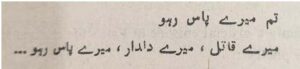
A great depression descended upon the Western world, with the breadline and the soup kitchen as its prime symbols. Economic setbacks brutally battered America and England’s industrial north, and while a hungry world watched, Germany began feeling the lash of fascism on her back. The years of the Great Depression, with its working-class victims, could not be ignored by a generation of young intellectuals for whom genius had become a burden. Faiz could see the effect all this had around him. Khurshid Anwar, N M Rashid, Krishan Chander, Bedi, Manto, Ismat Chughtai – talented, some even touched with divinity fell prey to a common distortion of vision. Rancour and bitterness soured them. Manto became the anguished cry of a lost generation; Khurshid Anwar drowned his immense musical talent in his association with Bhagat Singh’s terrorism.
Only Faiz continued to transcend the barriers of time – man and God’s:

For some, the answer lay in the prophet-poet’s revival of the heroic age:

whose magical presence was supposedly to result in change:

For Faiz, however, the answer lay initially in a denial of personal love:

And for him the people were not the heroes of old but the mongrels that haunted the alleys and skulked in the shadow. Salvation lay in a conscious awakening; arousing from stupor:
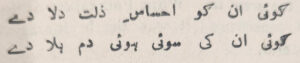
On the world front, nationalism proved to be the major causal effect of the Great War. While the faint, rambling rumblings of the Russian Revolution rolled across the Steppes, the Third World began etching its features on the global canvas. Faiz himself was never a rootless intellectual.
A healthy idealism balanced his captivating romanticism. He responded readily to the nation’s embryonic stirrings against colonial rule and understood that the struggle would mean a people’s war. But for five long wretched years, the world turned its attention to a primaeval struggle between good and evil.The struggle for independence was shelved while all that was good, just, and beautiful fought a war of life and death. Faiz found himself in the Army Public Relations:
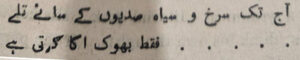
When the holocaust ended, the struggle for a free homeland resurfaced in poems such as:
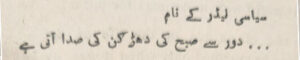
For Faiz, the bloodbath that freedom came soaked in could only be expunged, washed away by the building of a raw Pakistan on the principles of social justice and progress.
It was expected that the full-throated roar of a free people’s joy would make the very heavens shake except for the lament of millions of orphans and homeless people:

Faiz in his compassion and horrified sorrow branded the very people who had led the struggle and had failed to cope with the horror of Partition. He seared the conscience of the people and with increasing experience and a growing maturity comprehended the simple truth that a true poet is also a responsible citizen. His poetry became the voice of a people exploited ironically enough in their own promised land. The fruit was bittersweet for while Faiz introduced Marx to his people as Iqbal had Nietzsche, it earned him the undying hatred of those whose entire lives were built on the great lie. While Faiz talked of the concept of justice, truth, and the man of conscience, it was the beginning of the persecution which followed him to the very end.
The much-awaited freedom of 1947 quickly degenerated into the freedom of the few to tread upon the many. The millions who migrated to Pakistan were the first of a series of excuses for aid which somehow never helped the people in whose name it came. The final serving of the severing of the limb from the body came with the Kashmir war in 1948, parting people who had lived together for centuries. It was symptomatic of the people’s bitterness that independence lost its significance in the lacerating synonym: Partition.
Faiz, as the editor of The Pakistan Times, had to be silenced. The Rawalpindi Conspiracy Case trial unfolded its mysterious length in camera; a death sentence remained a lingering possibility. Faiz was sentenced to four painful years. Faiz’s prison term proved a well-disguised blessing. His wartime work had been heavy, and he had been enslaved by a tyrannical editorial desk. His health suffered, but he could read and, most important, think his own thoughts. If the purpose was to break the spirit, it proved futile. If anything, Faiz’s prison poems used the diverse image of the beloved, the homeland and its people into one poetic whole. That, more than anything else, made for Faiz a spiritual home in the socialist lands and aligned him with all the all-important worldwide movement for peace.
It was the end of an era in the life of the poet. Freedom, justice, patriotism were words to be mouthed only when it was useful. Yet somehow, Faiz remained insulated against the cold; he wrote: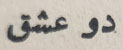
The duality visible in his early and middle poetry; a kind of struggle to reconcile two contradictory visions of life were somehow resolved. Faiz began to realise that any artist’s true function lay in a just balance between two demands and not necessarily an identification with anyone. A powerful artistic sense began to combine with a mature realistic spirit which recognised the dangers lying inherent in the long dark nights of terror and depression that the nation began to live through and remained undaunted:
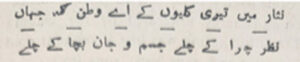
In those years, it was only Faiz’s voice, only Faiz’s vision which fused the land, its people, the Creator and the created, body and soul into one coherent entity:
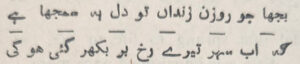
Even in prison, Faiz’s thought transcended death and lamented his isolation and separation from the people, the land and life itself. Not for nothing did the poet resort to growing flowers in prison– as ironic and as poignant a picture of Eliot’s corpses that would not bloom despite April showers. It was as though the fragile beauty of the flower was the slender bridge linking the poet to a world he missed with a passion. He wrote:
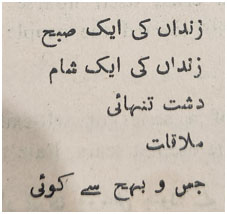
The landscape is dyed a glory crimson with its overtones of wounds, passion and suffering:

But anguish keeps the spirit alive:

The victims were always the same. The names and places changed; the Rosenbergs in America – the students martyred in Iran during the Mosaddeq episode resulted in:
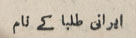
It was innocence that was martyred. Each time the blood staining the thirsty earth was the elixir which brought to life the barren soil itself.
With the 50s came partial relief. With Independence a mere decade old, the idealism dynamism and energy generated by the trauma of ‘47 was already dead or dying. The life of the nation was like a stagnant pool; a tropical summer afternoon; asphyxiating, sans end, sans hope, sans joy:
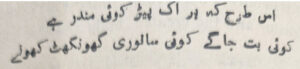
The glittering idol that sprang to life out of the stillness was the military regime of 1958. Faiz was imprisoned once more.
All laws were abrogated; the rights of men held in abeyance while the rulers rapidly imposed the rules of the chain and the gibbet – until the only music left in the land was the clink of chains:

In a few years, truth had cried itself hoarse while the rulers dropped all pretences of tolerance, goodwill toward the people and the pursuit of a just social order.
It was time for the first of a series of self-exiles. And though banishment, voluntary or imposed, inflicted the deepest scars, Faiz’s spirit soared beyond exile:

Faiz Ahmed Faiz was awarded the coveted Lenin Peace Prize. With this first recognition of a citizen’s commitment to his people, a commitment to all peoples of the world, the poet came into his own. The award was grudgingly accepted by the ruler and ungraciously never publicly acknowledged. A new phase in Faiz’s poetry began. He became more experimental and resorted frequently to free verse. It was as though his spirit and his art had freed themselves of all confines. His deep-rooted romanticism reflective of personal fulfilment, served to complement the occasionally ambiguous, abstruse sentiment in his work which prophetically warned of the sun-bleached dissolution and desolation to come:
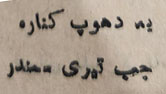
The military regime decided to play democracy. Ayub Khan won and at his son’s victory procession for the father the accompanying police contingent fired on opponents killing many in the poorest quarters of Karachi. News of the massacre was suppressed and blood which is the symbol of life became a symbol of death. The ancestral blood; the common heritage of a people bound the poetic consciousness in a great linkage of destiny and time as it flowed through the veins of generations:
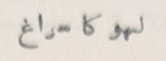
The movement stretched into an eternity, the silence broken by the scream of jets in the air and the air became thick with the roar of guns. September ‘65 and Pakistan went to war with India; the first purely sensory experience of the war was the blackout:

This poignant loss of sight was inevitable for a sensibility which had continued to see his own people on both sides of the border.The patriot found himself in the midst of a war in which he was a patriot for both sides.
In rebellion and desperation, the spirit responded with the “Lament for a Soldier”. Out of a sum of little words, the poet created a world older than time itself:

The war was no ordinary war; it was a war of no Herculean conquest or earth-shaking victories, parades or brass band – it served only to sear the souls of nations. But the irate god of war was not done yet and he turned his baleful eye toward the virgin sands of Sinai. And all too soon the dunes still dazzling with the presence of the Godhead lay stained with the blood of the child of man:
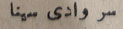
This – the deepest of all life’s secrets, the secret that all great poetry and the mysteries religions attempt to penetrate became the moving force behind Faiz’s passionate involvement with the land of our forefathers. He had understood where the sun-blinding clarity of committed genius that the One operates through all souls however detached they may be; that the supremacy of man and the quality of his intellect depends on the degree of love and compassion that he can muster for the wretched of the earth. It was no easy lesson for the knowledge drove him relentlessly and periodically away from home.The retreating Palestinians marching to a song written by him, Beirut and the hail of Israeli bullets during the invasion of Lebanon – these reinforced Faiz’s commitment to a humane peace, to a just and equable social order.
At home things were worsening. Bangladesh was born soaked with the blood of thousands. Ayub was succeeded by Yahya and twelve years of repression exploded into a civil war that tore the country apart:

The shattered fragment that was left of Pakistan returned to civilian rule under Zulfikar Ali Bhutto. Bangladesh, the living scar on the nation’s soul, was recognised, and face was a member of the first official delegation. Poignantly, where a few years earlier there had been companions and countrymen, there were now aliens; men with strange faces speaking a strange language:

“I want people to breathe” – the new President was addressing the nation for the first time on TV. And for a while the air was clean and free and men could think:
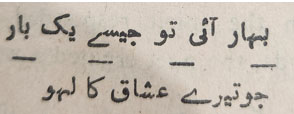
Servitude or freedom? The first five years up to 1977 still await the verdict of history. No one however doubts that they were the crucibles of force – old and new. A sensitivity began to develop in the awakening millions. They watched with amazed men and finally with triumph as the older forces began talking to them in their language, using the people’s idiom, aping their dress, mimicking their manner. But the rulers were ruthless in their effort to prevent the people’s triumph from taking on a new shape. They were convinced that the change was to be only skin deep, that it must confine itself to a new form of dress and a new informality of language. Ironically enough, the potential inherent in the power of the people became a threat to the very people who had sown the seed and ridden the crest of the wave.The older forces were equally convinced that their survival lay in the destruction of the people responsible for awakening the sleeping Colossus.
And as often happens at such times, the larger dream of the future lay forgotten – buried under the small desires of power-maddened men. It was then that the petty, indescribably vulgar struggle for inheritance began. The problem lay unresolved until elections were announced in 1977. Loved, hated or feared – the people could not be ignored.The frenzy on both sides was saturated with colour – posters, banners, processions, badges, bunting pictures plastered the walls or flapped in the breeze:
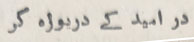
The raw forces, aimless, violence, shattered the delicate crucible and a darkness descended at noon. Faiz and with him an entire people were alienated and exiled from their own soil:
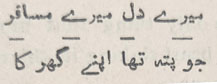
The darkness was relieved only by shafts of agony and the despair of the multitudes. 1979 put the final seal on the darkness. Faiz in exile in Tashkent wrote a lament for time itself:
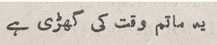
And the bloodletting continued:
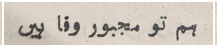
Home became Beirut, home of Lotus and home to the Palestinians, the last of a long line of homeless nations. For a time this course was home and then the cause itself became homeless – the Palestinians left Beirut and Faiz with them:
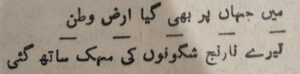
The scent of blossoms and the pain in the heart could not prevent a sense of despair from creeping into the soul of the nation – a nation despairing of the future, looking back on the past, wondering:
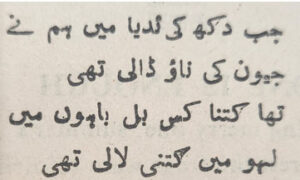
Faiz could no longer stay away:
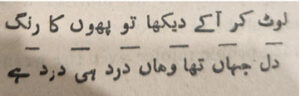
The colours of the landscape had faded away, the flowers breathed no perfume; misery darkened the brow and hopelessness shone duly in the eyes:

The living land had become a wasteland – a land of hollow men, shadows lengthening into the dusk, devoid of substance or hope:
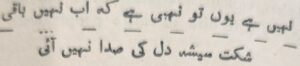
In the barren stillness, the only thing that moved was ruthless desperation, it stalked the land like a wild beast shaking its thirst with a draught of power, gnawing at the soul for its subsistence:

People in Sindh tried to hunt the desperation out, flushing it from its lair with the scent of their own blood, but the hunter became the haunted. All pathways to the trackless desert were sealed off:

Faiz was tiring now; the indomitable spirit flickered in the wind and then there was a darkness. In the end they all came. The slender feet clad in their hand-made Italian shoes, the cigar-smoking culture parasite and the official. But they were not the ones who mattered.The ones who did, came ankle-deep in the dust of the land, their work-torn hands in the salute, their hearts laden with pain. It was to them that he had spoken and they knew that it was only he who had understood their silence.The lad mourned him and the true men of his land mourned him. It seemed on that day that the order of blood was in the air; it scented the flowers and coloured the river and blew in the wind.
At the time of publication of this piece in The Ravi, the writer was an Assistant Professor, Department of English, Punjab University, Lahore.