Volume 8, No. 11, November 2026
Editor: Rashed Rahman
How an editorial decision about Faiz Ahmad Faiz turned my life upside down
Abbas Zaidi
By the end of 1984, General Zia’s Islamisation, supported by martial law, was complete. In August that year, he amended the Constitution (Sections 298-B and 298-C) to purify society, opening the door to court- and mob-lynching of ‘blasphemers’. (In 1992, Zia’s heir Nawaz Sharif amended the Constitution, prescribing a mandatory death penalty for ‘blasphemers’.) Along with the amendment, he gave carte blanche to the Deobandi Sipah-e-Sahaba (it later metastasised into Lashkar-e-Jhangvi, the Taliban, Jaish-e-Mohammed, etc.) and thus initiated the Shia genocide (for details, read my papers in Faith-Based Violence and Deobandi Militancy in Pakistan).
On the political front, too, by the end of the year Zia had secured all the victories he desired. Political resistance had been crushed. The very mention of the Shahi Fort of Lahore sent shivers down anyone’s spine. On a personal level, Zia had every reason to feel confident. No one could say “Zulfiqar Ali Bhutto” in public without being sent to the Fort to be mercilessly killed or mutilated. Benazir was in exile, and there was no hope of her return. If her name appeared in the media, it was as a traitor and the daughter of a traitor.
I am aware of some of the horrors of Zia’s military rule (1977-88). Professor Shoarat Bukhari, who taught me Urdu at the Islamia College, Civil Lines, was jailed and tortured for supporting Zulfiqar Ali Bhutto. His wife, Farkhanda Bukhari, was thrown into the Lahore Fort, where she was tortured for months, and her body parts were burned with cigarettes for weeks on end (Read her Ye Bazi Ishq Ki Bazi Hai for details). Since 1979, my good friend Agha Naveed had been in the Fort for shouting “Long Live Bhutto” in public. He was released after Zia’s death in 1988. Nine years of torture left him with twisted legs. Taking a few steps was a mammoth effort. That he remained sane was a stupendous achievement in itself (Read his account of the horror of the torture in the Fort, Doosra Janam).
The dystopia was there, and the West and the Gulf monarchies amply sustained and supported it.It was about this dystopian world of Pakistan that Faiz Ahmad Faiz wrote:
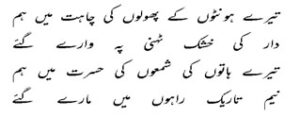
(In the desire for the flowers that were your lips
We were sacrificed on the dry branch of the scaffold
In the yearning for the light of your hands
We were killed in the darkening streets).
Interestingly, Faiz Ahmad Faiz died in November 1984.
However, within the grand narrative of Pakistani dystopia, the small narrative of my own life was not oppressive, or at least did not seem so. I thought things were going my way, and signs confirmed my optimism. I was completing an MA in English literature at the prestigious Government College, Lahore, and was president of its Sondhi Translation Society. Above all, I was the editor of The Ravi, the oldest and most prestigious college/university magazine in the Subcontinent. Established in 1911, it had seen its editors rise to the highest glories of their professions (I confess, I remain an exception). The MA in English consisted of two parts. I stood first in the college in Part 1. Typically, the principal would appoint a top-performing student as an ad hoc lecturer, and in a few months he or she would be made permanent. While congratulating me on my Part 1 success, the principal told me he would give me an ad hoc lectureship if I maintained my position in Part 2 as well.
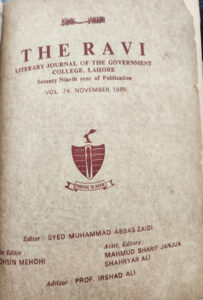
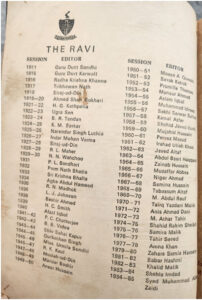 During my Part 2 studies, I was appointed editor of The Ravi. I studied hard to maintain my academic performance while producing a good edition of the magazine. I wanted to produce a memorable edition. I spoke to several people. Since Faiz Ahmad Faiz was a Government College alumnus, I decided to publish a couple of articles on him. Some of my friends warned me against the idea because Zia hated Faiz, and his heir-cum-protégé was then the all-powerful chief minister of Punjab. Moreover, as an alumnus of Government College, Nawaz Sharif had been interested in the college’s affairs, and he decided to appoint the principal despite protests from several academics, journalists, and well-informed people, because he was known as an incompetent sycophant. But Nawaz Sharif was too powerful to value criticism, however valid. Since Faiz had been Pakistan’s ambassador in the Soviet Union during Bhutto’s rule, and at the time of my editorship the anti-Soviet Afghan jihad was at its peak, I was warned that I could end up in the Lahore Fort like Agha Naveed.
My counter-argument was that General Zia and Nawaz Sharif were too powerful to be upset by a couple of articles in a college magazine. I spoke to Professor Irshad Ali, the Ravi adviser. He said, “You are the editor. Use your editorial judgement. I will stand by you.”
I wanted Professor Aziz Butt, my teacher and guru at Government College, to write an article on Faiz. He was reluctant, but I knew how to persuade him. He dictated the article to me in one sitting. Professor Razi Abedi of the Department of English at the University of Punjab got one from his colleague, Naveed Shahzad, a student of Professor Aziz Butt.
 To cut to the chase, the proofs were in the press when arrangements were made to photograph the editorial board with the principal. He was very kind to me. The result was announced a week before the photo session, and I topped the college again. At the photo session, the principal was upbeat. He congratulated me on completing the MA in “flying colours” and said my appointment letter would be ready once my MA result card was issued. My dream was about to be realised, a rare thing for someone in Pakistan with no contacts or networks, even social skills.
I had fully mapped out the trajectory of my dream life. I lived in Old Anarkali. It took me five minutes to walk to the Punjab Public Library. From the Library, it was a ten-minute walk to Government College via the Lahore Museum and Punjab University. My dream was to spend my professional life teaching English literature at Government College, reading as much as I could, and writing journalistic articles on English literature for newspapers in the style of Zeno’s “Cultural Notes” in Dawn. Zeno’s real name was Safdar Mir. He taught English literature at a college in Lahore but quit to focus on writing literary articles. He was a good friend of Professor Aziz Butt. He told me to write like him. I also wanted to interview retired English professors and publish articles about them. Professor Butt planned to write books on Ghalib and Manto. The plan was for him to dictate his articles to me, which we would later collect into books. I had no desire to leave Lahore, write fiction, or write research papers. I knew that after retirement I would continue to live in the Old Anarkali world, spending time in the library and occasionally delivering lectures at my alma mater while fully engaged in reading and writing. I did not want anything else.
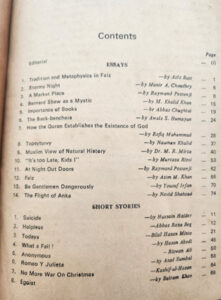 A week after the photo session, the 1985 issue of The Ravi was published. The manager was shocked to read Naveed Shahzad’s article, in which she denounced various martial law regimes. She also praised Zulfiqar Ali Bhutto. Beyond that, no one seemed to have noticed. But a gentleman, a former student of Government College, had been waging an unsuccessful campaign against the principal. Let’s call him Mr Shah (it was/is part of his name). He was my friend too, and he’s now on my Facebook friends list. He took a few copies of The Ravi and knocked on as many doors as possible, claiming that the principal was a Bhutto supporter and was behind the publication of the articles on Faiz. It created a proverbial storm in a teacup for the principal. I do not know if someone in the official hierarchy pulled him up for publishing those articles. But as far as I was concerned, Mr Shah’s vendetta campaign brought my dream crashing down. Thus, when I went to the principal’s office to remind him of the letter of appointment, he refused to meet me. His secretary told me I had to follow the usual recruitment process and apply for a lectureship with the Department of Education. By applying to the department, I would have gotten a lectureship, but not in Government College.
Everything I had planned for my life ended there. I never returned to Government College to collect my degree and the role of honour awarded for the editorship. I left Pakistan, studied and taught in different countries, and wrote books and papers. Whatever I have achieved means little to me when I recall how much the dream meant.
The writer lives in Sydney: abbas.zaidi@unsw.edu.au