Volume 8, No. 10, October 2026
Editor: Rashed Rahman
Unfinished Revolutions
Exiled activist and filmmaker Roshaan Khattak takes a personal look at the silencing of young people in Kenya and compares it with the persecution of resistance movements in his home country.
On a recent trip to Kenya, I found myself thinking back to Balochistan. For the past several years, I have been researching the crimes against humanity and the resistance movements in that area. When the threats began, anonymous emails, veiled warnings and the quiet message that I had “gone too far”, Cambridge University told me they could no longer guarantee my safety. They shut down my project and asked me to leave, a quiet reminder that even universities bend when powerful states threaten. So I left. Unable to go to Pakistan, I decided to spend time in Kenya, a country whose history of anti-colonial struggle I had long admired. Thomas Jeff Miley, sociology professor at Cambridge, specialising in self-determination struggles, also happened to be in Nairobi at the time. While staying with activists in an informal settlement, he put me in touch with social justice organisers who were brilliant, grounded and unafraid. They reminded me, almost painfully, of the Baloch and Pashtun activists I had known back home. Although I had not been to Pakistan in years, I saw their reflection in these Kenyan youth. They shared the same clarity of purpose, the same willingness to face a violent state, the same refusal to be afraid.
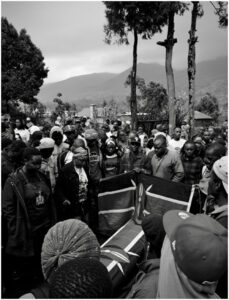 Funeral of Wanjau a leader of social justice movement. Killed under mysterious cicumstances
The checkpoints and the chaos, the hunger and the courage, the stories of missing friends – all of it in Kenya echoed Pakistan so closely that my exile felt temporarily suspended. I was far from home yet surrounded by the same despair and defiance that had shaped me.The more stories I heard, the more familiar everything sounded. Kenya and Pakistan are separated by half a continent and a sea, yet they speak a common language of repression. Both are post-colonial states that inherited the coercive machinery of empire – secret prisons, paramilitaries, collective punishment – and learned to use it against their own citizens. In such systems, power is measured by the ability to decide whose lives are protected and whose deaths are tolerated.
Kenyan activists told me about friends who never came home from protests. Some were last seen dragged into unmarked cars by plainclothes men. Others turned up in morgues bearing the marks of torture. Police opened fire on unarmed demonstrators last year, killing scores of young people demanding economic justice. One organiser described how, after a night of protests, she spent hours calling hospitals, trying to locate a missing colleague. Her words echoed the laments of Baloch mothers I had interviewed, each clutching a photo of a son who vanished after an army raid. In Balochistan, such disappearances are systematic. Thousands have been abducted by Pakistan’s intelligence agencies or by the death squads they sponsor. Some victims reappear months later in court; most are found dumped by the roadside, bodies mutilated. The message is consistent: the state can take you at any time. In both places, the disappearance functions as the ultimate disciplinary act – not just silencing the individual but terrorising the collective.

Kenyan activist Wanjira Wanjiru
This violence is not chaotic, it is bureaucratically rational. Kenya’s police force operates under a broad ‘special operations’ framework built during the British counterinsurgency against the Mau Mau. Pakistan’s army perfected its own counterinsurgency model during the Cold War, aided by American and British advisers. Each learned that intimidation and denial are cheaper than reform. Each discovered that in the absence of accountability, violence becomes governance itself.
Both countries embody what the writer Frantz Fanon warned of: national liberation without social liberation. Independence merely transferred the colonial state to local elites, who quickly realised its instruments of domination were too useful to discard. In Kenya, the families who replaced British settlers seized the land but kept the logic of the plantation. In Pakistan, the military inherited the Raj’s garrison mentality and its contempt for the frontier peoples – the Baloch and Pashtuns – who had resisted imperial rule.
The results are grimly parallel. Nairobi’s poor neighbourhoods – Mathare, Dandora, Kibera – operate as internal colonies, policed and punished as occupied zones. Pakistan’s peripheries – Balochistan, Waziristan, the tribal belt – are subjected to endless ‘operations’ justified in the language of security and development. In both, dissenters are branded as extremists or foreign agents. Their deaths, when they come, are written off as accidents or counterterrorism successes. A Kenyan lawyer told me that after the colonial hangman was retired, the police simply became the new executioner. A Baloch journalist once said much the same: “The British built the prisons; we just filled them.”
Several Kenyan organisers spoke of mysterious gangs that appear during demonstrations – men with sticks and machetes who beat protesters while police stand aside. Everyone knows they are hired by the state. It reminded me of Pakistan’s practice of using proxies to wage internal wars: Taliban factions unleashed on Pashtun regions, or armed criminal groups in Balochistan tasked with targeting nationalist activists. In both contexts, violence is outsourced to maintain plausible deniability. The thugs are disposable, the system endures. Repression has become privatised, blurring the boundary between state and underworld. The government points to the chaos it manufactures as proof that it must remain in control.
Yet repression is never total. Beneath the fear runs a deeper current of memory. The Kenyan Gen Z organisers locate their struggle within a lineage that stretches back to the Mau Mau rebellion. They read Marx and Fanon, remixing them into TikTok manifestos. One activist told me, “Our grandparents fought the British, we’re fighting their students.”
Their chants sometimes carried echoes of old Mau Mau freedom songs:
“Tûgûtigewendo, tûgûtigeûthamaki,
Tûkûmbukeatûmia aitu maitu.”
(We will abandon servitude, we will abandon the kingship,
We will remember our mothers and our grandmothers.)
In Pakistan, the same moral music survives in the poetry of Faiz Ahmed Faiz, still whispered at protests and vigils for the disappeared:
“Hum dekhen ge, lazim hai ke hum bhi dekhen ge,
Woh din ke jis ka waada hai.”
(We shall see, it is certain that we too shall see/
The day that has been promised.)
Across continents, these lines rhyme in spirit if not in tongue: a vow that history’s debt will be paid, that liberation – delayed, denied – remains inevitable.
Technology has changed the terrain but not the logic of struggle. Kenyan and Pakistani activists alike rely on the internet to document abuses and coordinate actions. Videos of police shootings or military raids travel faster than censorship can erase them. But the state, too, has adapted – deploying surveillance, troll farms and internet shutdowns to smother dissent.
One Kenyan journalist told me that the government’s digital monitoring unit “knows before you tweet”. In Balochistan, entire districts lose internet access whenever the army starts an operation, leaving families unaware of what happens to their loved ones. The internet, once seen as a tool for freedom, has turned into another area of control.
When I asked a Nairobi student what kept her going after months of arrests and killings, she shrugged. “We don’t expect justice,” she said. “We just refuse to be silent.” Her realism reminded me of a Baloch activist who once told me, “They have taken everything from us except our voice, so we’ll keep shouting until that too is gone.” Neither expected victory soon. Both understood that resistance, in itself, is survival.
It is tempting to find hope in the courage of these movements, to end on an uplifting note about solidarity. But optimism can be a kind of amnesia. The reality is that the global order rewards repression: the IMF applauds austerity, the UN issues mild concern and the West trains the same forces that disappear our friends.
Yet the continuities of repression have also produced continuities of resistance: a shared political imagination that stretches from the Mau Mau forests to the mountains of Balochistan, insisting that freedom means more than a flag. It means a new social order built on dignity and equality.
Until that reckoning comes, the disappeared will remain our truest historians and the streets of Nairobi and Quetta will echo the same unfinished cry: freedom from those who claimed to deliver it.

Rastafarians meet up in Nairobi. They are increasingly getting involved in social justice movement.
The writer is a human rights activist, Cambridge scholar and Oscar-nominated documentary filmmaker from Pakistan, currently in exile in the UK.